05 August 2013

Second to None! On subsequent sentences and where they go when ignored.

I actually hate the number 8. A couple birthdays aside, August is my least favorite month. I'm not fond of "L8R" either. There's just something about that smugness it carries. Round at the top, round at the bottom, perfectly even, 4+4, or its "oh so" clever 2+2+2+2 business. So here it is, that dreaded month: the end of summer, the start back to school, the hottest time of the year, the days when dogs eat grass (I've heard it said). At this point, there is no more "endless summer".

And all I can think to do as my first August blog is to share some sentences of no particular import. On a recent trip, I had hours of driving to contemplate the opening sentences of THE DREAM LAND trilogy. Now that Book III is complete and being edited, I must return to that weak spot I've always had: the opening sentence.

Countless author blogs have reported on the necessity of a great first sentence, as though that alone tells potential readers (bookstore browsers, etc.) all they need to know about the book. Alternatively, an old literature professor--the one who actually taught me something useful (as a writer, not as an English professor)--said that a good author will teach the reader how to read the text in the first few pages. Pages! Not one all-important sentence. (Also, note the word 'teach'; thus, it's not 'You stay in your world and try to understand this text'; 'No, you must come into my world, the world of the text, but fear not for I shall guide you....')

Well, I subscribe to the latter notion. If a potential reader will not read the second sentence or others beyond the first, perhaps that reader should stick to graphic novels or Twitter. Not to be disrespectful to a majority of our finer readers, for an opening sentence is still important to setting the story in many ways; however, like much of literature, an opening sentence is intended not to stand alone but to lead to the next sentence, and that second sentence to lead to the third, and so on. It's a whole industry, not a sample bite in a grocery store. Have some patience, dear reader!


To that end (er...beginning, whatever), I look strongly at the second and third sentences and note how they proceed from the opening sentence. That shows me flow. More often than not, there will be a joke or some clever juxtaposition that strikes interest in the reader...several sentences down from that first word of that first sentence. The images, the word play, the introduction of a character or setting...the accumulation of ideas...is what catches the interest of the reader [I suggest].

By way of example, I offer the opening paragraph of each of the three volumes of THE DREAM LAND Trilogy, for your amusement today:


“I was face up in a vast snowfield, sun on my face, and all around me were hundreds of half-buried skeletons. The yellow sun was glaring off the snow, blinding me, and the blue sun was winking at me from the horizon, but all I could think of was ‘I’m freezing to death!’ They took my greatcoat, and I didn’t have any boots. In fact, I couldn’t feel my legs below the knees. I wanted to check them, but I was too frozen to move. I wanted to cry out for help but I was afraid of calling the ones who did this to me. I kept thinking ‘It’s all a mistake’ and ‘I don’t belong here.’ Then I looked up at a small branch stretching over me. I followed the branch to its end and there was a single drop of thaw hovering there. It was about to fall. I watched it for a moment—then it fell! Straight down to my legs! It hit my legs—which were frozen solid—and they shattered into a million splinters! There was nothing left but stumps! And I cried my brains out in pain—but there was no pain because everything was frozen! And I was wondering how the hell I was going to get home without my legs.”

This monologue is intended to come out all in a rush to create a tossing of imagery fast and furious, to create a composite image of a scene...a dire, wintry situation...which may or may not be resolved in the next paragraph.


The yellow sun was beginning to warm the room, the misty, frayed globe high enough that he knew dawn was coming to an end. The blue sun was still below the horizon.

One paragraph, short and sweet. All seems fine in the first sentence. The second, however, adds a twist which is scientifically designed to pique a reader's curiosity.


THE DREAM LAND Book III “Diaspora”

He felt the sand scratching his face before he opened his eyes. A faint dream hovered wallflower-like at the edge of his dance card, afraid to let itself go and twirl about the floor no matter who might be watching. Letting the image sail away on a breeze, he pushed out his legs, stretched his arms up, bent his neck—and in every movement felt pain shoot through his body like lightning, like fire and ice. He stopped, grimacing against Fate once more, like some old habit his mother had scolded him for. When his eyes opened he saw what he had expected to see, yet the sight of the desert landscape, red and brown below the emerald sky, seemed to catch him by surprise.


Textures is the theme of this opening paragraph: imagine yourself waking up in the desert. And realizing your Fate is not quite as you expected it to be. You are in trouble!

So there you have it: examples of second (and third, etc.) sentences flowing from first sentences. I hope now that everyone will henceforth pay more attention to those sentences who do not come in first but still try so very hard!

Next time: The importance of a mind-blowing final sentence.


---------------------------------------------------------------------
(C) Copyright 2010-2013 by Stephen M. Swartz. All Rights Reserved. No part of this blog, whether text or image, may be used without me giving you written permission, except for brief excerpts that are accompanied by a link to this entire blog. Violators shall be written into novels as characters who are killed off. Serious violators shall be identified and dealt with according to the laws of the United States of America.

29 July 2013

The Big F ...or, whatever it takes to get your attention

Dear Blog Readers and associates,

It's no secret that I like to write. People who know me think my name is Writer. The flies on the wall see me writing almost every minute of my waking hours. That is, when I am not engaged in my so-called day job. And what is that day job, you may well ask? I teach writing. Ironic? That brings us full circle, doesn't it?

However, lately I have begun to notice the curse of writing. I tend to write too much! Case in point: this past weekend I cranked out 15,000 words to finish the draft of the third book in my sci-fi trilogy, THE DREAM LAND. Yes, you've heard it all before "...greatest interdimensional epic ever!" That weekend word count might be an all-time record for me.

In speaking about blog entries, however, I do tend to write too much. It is said that most readers of web pages typically scan the page in the shape of the letter F. (I do not expect my readers to believe me because I know they are appropriately skeptical of anything an obsessed fictioneer says, so here's one of many links: F-Shaped Pattern.) Readers read more closely the first paragraph, to see if they want or need to read more. (I wonder how this correlates to how college students read the required texts.) Then readers tend to scan down the left edge, picking up bullet lists, etc. If there is something else of interest, a bullet list representing quick and easy information, then they will slow down to read more, hence the second horizontal line of the F.

Have I gotten you to the second horizontal line of your F yet?

Probably not. I don't write that way.
I write as I was taught years ago, pre-computer, pre-web page. I save the most impactful information for the end, when I summarize my argument and present a conclusion. The essay format. That's what I teach--because that's what Academia wants students to learn: well-thought out, well-organized, argumentative writing--taught in the English course but for use mostly in every other course of the curriculum. Not personal web pages or Facebook, or Tumblr, or the 140 character Tweet.

Are we there yet? To that second horizontal line? (Did the red catch your eye?)


In my last blog post I waxed poetic on the exigencies of exoskeletons in everyday life, and especially so in science-fiction literature, to which I am adding my epic trilogy. (Let me put that in red to draw your attention to it.) Because of my tendency to write too much, I easily outpaced many dear readers. I thus ran out of space for including an excerpt on exoskeleton use from THE DREAM LAND Book III "Diaspora". Fortunately, on my blog, I can do pretty much whatever the heck I want to do--even as I consider the limits of my readers' patience.

If you are ready for the second horizontal line of the F, here is that DREAM LAND III excerpt:

Chucker took the remote control and studied the buttons layout. He pressed the yellow circle at the top and the fuel cell taped in the small of the man’s back showed a yellow light and hummed. He pressed the other, smaller yellow buttons across the top and other parts of the exoskeleton came to life.
“It is aliiiiive,” said Chucker with a snort. “Let’s see if we can get you up on your feet.”
The joints moved smoothly with the power on and Chucker eased the man into a sitting position, the frame cradling his hips and supporting the back, firming automatically to hold him in that upright position. Chucker helped him turn his legs off the table, lowering them until one foot platform touched the concrete floor. The rest was done my remote control.
“Relax,” said Chucker, giddy with his success. “Let the machinery do the work. Trust it. It won’t drop you and you won’t stumble. I’ve seen it work. See, there’s a gyroscope in the unit that’s fixed to your back. But don’t resist the system or you could break some bones. Think of it as a robot that is walking you around and just enjoy the ride.”
A shadow fell on the floor.
“Excuse me,” said a voice not from the man in the exoskeleton.
Chucker froze. He was certain he had locked the door. He had. But a man had entered from the restroom side. He looked up.
“Sorry to bother you, but my boy....” The man was dressed as a tourist, and paused to wonder what was going on in the Education Center on a blustery October Saturday afternoon. “He really got to go and the restroom over at the African Market is out of order.”
Chucker saw a boy of six or seven hiding behind the man’s legs.
“Sure...aaa...go right ahead.”
Remain calm. They probably don’t have any concern for what you’re doing. They probably don’t know a serial killer has escaped his handlers and is hiding out with a madman from another world.
He heard the dad giving instructions to the boy, the words echoing back to him, and he thought of his own children, waiting so long for him to return, insistent as he was about completing this final mission.
“What’s that thing, mister?” asked the boy, proudly exiting the toilet, slow to hitch up his pants.
Chucker did not miss a beat as he stared at the man in the metal transport frame.
“It’s a robot. We’re getting ready for a carnival. Somebody is having a birthday party later and we are the entertainment.”
“That’s cool!” said the boy. “Does he do tricks?”
“Sure, he does.” Chucker pushed the right blue T-shaped button and the right arm swung from beside the body to a Heil Hitler salute and back down again. He pressed the left T-button and the left arm repeated the movement.

Too irreverent to the science? To a paralyzed man in a wheelchair being rescued/kidnapped via an exoskeleton? 

I'm sorry. No, I'm not.

I suppose I must simply accept my fate: Readers will rate this post an...


---------------------------------------------------------------------
(C) Copyright 2010-2013 by Stephen M. Swartz. All Rights Reserved. No part of this blog, whether text or image, may be used without me giving you written permission, except for brief excerpts that are accompanied by a link to this entire blog. Violators shall be written into novels as characters who are killed off. Serious violators shall be identified and dealt with according to the laws of the United States of America.

18 July 2013

Got your Exoskeleton yet?

Greetings and salutations, dear bloggers and bloggettes!

Today I welcome you to yet another lesson in "You're Writing Sci-Fi but the Amazing Things You Think Up Already Exist". This is often the conundrum modern sci-fi authors face. There is an on-going race to out-think the current scientific discoveries and applications, trying to stay amazing and fantastic and futuristic. I'll never give up, however!

Case in point: My novel THE DREAM LAND Book III "Diaspora" has a plot line whereby a quadriplegic man in a wheelchair is about to be kidnapped by his buddies who wish to save him from his life in a prison hospital. Fair enough. How to do that, however, may cause some pause. I admit I paused. (I'm the sort of writer who doesn't really think ahead too far; I write myself into corners all the time, then have to go think of a way out.)


Step 1: Isolate him. Get him away from his wife and child who accompany him. Get him away from the eyes of the two agents monitoring him from a short distance.

Step 2: Load him and his wheelchair in a van, drive away.


Seems simple enough, right?

Wrench 1: They are in a zoo on a Saturday afternoon, a small but steady crowd of visitors milling about.

Wrench 2: The gate you had sawed the lock off of has had a new lock put on [expletive]!

I think it still may be do-able. How about you?

Random Act 1: Pushing him up the slope from one section of the zoo to enter a different section, the wheelchair gets away and rolls backward down the slope, crashing into the wall around the sea lion pool and tossing our quadriplegic friend head over heels into the pool. (Did not see that coming!)

Random Act 2: Wheelchair is busted from crash into sea lion pool. How are we going to move him out of the zoo and into the waiting van? Furthermore, he's all wet--what to do?

Here's where the wonders of interdimensional travel come into play--as they always do in THE DREAM LAND Trilogy!

Voila! Our protege has special equipment: an exoskeleton. What is an exoskeleton? Any accessory which enables a person to exceed normal degrees of strength, speed, and agility. You can see an early prototype: the Man Amplifier. In larger configurations, an exoskeleton is like a robot but with a human inside. The exoskeleton fits around the person. You may have seen them used in a military context (See Avatar, etc.) where the man inside can "walk" and "fight" using the machinery's superior strength. I thought it would be so cool to use an exoskeleton to get their friend out of the zoo. I thought I was being innovative, forward-thinking, and damn clever.


(In the film AVATAR, they were called an Amp Suit.)
Currently, you can see a similar exoskeleton example in the film Pacific Rim. In it, two operators operate from within what are essentially large robots. Nice idea--but I had it first! A lot of video games also make use of exoskeletons--but I don't play those games so how could I get the idea from them? Is it a case of great minds thinking alike? Seriously?


Alas, my exoskeleton already exists! And not just in other sci-fi productions. It is already used for various medical applications. That was my thinking. Seriously, I thought of it first. I mean, I thought of it before discovering it already exists. Please let me have some credit for the idea. Please?

See how the exoskeleton supports the body and legs of a disabled person? Also works well as modern art, conversation piece, or silent companion.


They already tried to take away my comet crash! So I made my book about what people do, how they deal with the coming event--rather than about the event itself. If this sort of thing keeps up I may even need to change the titles! It's maddening to be a sci-fi author! Maddening, I tell you! Maaaaddennnning!

The only thing left is the humble realization that, if worn correctly, the exoskeleton will enhance not detract from a person's appearance. (Yes, it's a silly picture. Yes, I know it's sexist but the female version picture was all that I could find. I'm sure well-muscled males would also look good wearing an exoskeleton. They will be all the rage in a fashion season coming near you! I can prove this when THE DREAM LAND becomes a Graphic Novel!)

Book III "Diaspora" is coming in late 2013!


---------------------------------------------------------------------
(C) Copyright 2010-2013 by Stephen M. Swartz. All Rights Reserved. No part of this blog, whether text or image, may be used without me giving you written permission, except for brief excerpts that are accompanied by a link to this entire blog. Violators shall be written into novels as characters who are killed off. Serious violators shall be identified and dealt with according to the laws of the United States of America.

07 July 2013

The Metaphysics of Pizza

It's really very simple. If you have sworn allegiance to an organization whose prime purpose is to change history, then you have to stay flexible.

You might have to do any number of things. Even change it back, or change it in a different way than originally done. You may have to stop your colleague from changing something. That may require violence. Are you prepared to be violent? Probably you will be asked to affect your violence in either the mantle of Chaos or Order. But not both. And almost certainly, you will be offered pizza.

The lesson here is whenever you sign up with a mercenary outfit, be sure it is one in which pizza is served.

Excerpt from THE DREAM LAND Book II "Dreams of Future's Past" illustrates the sublime cosmological effects of pizza:

“It seems strange, Kanê,” Erutên-Vigasz spoke, sitting next to the Captain, “that we discuss who to kill over a meal of this round food. Is there meaning to your selection?”
The Captain grinned. “There is always meaning—to everything.” He motioned to the box on the floor at their feet. “See that box? It is square, suggesting conformity—rectangularity is hardly seen in nature—there is also restriction, limits. Yet, inside is the pizza: round, suggesting symmetry and order.”
Erutên nodded, thoughtfully.
“Why not put a square pizza in a square box?” the Captain continued. “Or a round pizza in a round box? The answer is simple: it is easier to make a square box than a round box. Folding cardboard leans to perpendicularity. To make a box one must work from the outer edges and fold inward. Conversely, it is easier to make a round pizza than a square pizza. The dough of the pizza begins from its center, a swirling ball of dough, then a disk that expands outward evenly as the creator whirls it around its axis. To then stretch out the disk, the circle, to fill the corners of a square pan or a square box requires unnatural action. It is natural, hence universal, for the roundness to remain.”
Others were now following the discussion.
“And yet, there, too, is a lesson to be learned! These forces, the squareness and roundness, are always working together and working against each other: chaos and order—one is always moving toward and becoming the other, constantly in flux, ever always changing, never fixed or satisfied, always seeking balance. Someday, while in flux, chaos will reach a point halfway to becoming order and at the exact same moment order will reach a point where it is halfway to becoming chaos, and both forces will swirl around each other and become one: neither order nor chaos, neither chaos nor order, but a singularity of multiplicity where all that ever was has been reduced to all that ever will be! Thus, all matter in the universe will become a microscopic dot too small for the smallest microbe to notice in the far corner of its jelly—so much smaller than the germ of a germ of a germ’s germ. And then, it could only be a mirror image and not an actual microbe—which would, of course, be contained in that germy dot—if all matter were compressed into the shape of a pizza, round not square.”

“I see,” sighed Erutên. “It is very cosmical, what you say. This world is—how you say?—interesting. I should like to learn more.”


THE DREAM LAND Book II "Dreams of Future's Past" . . . with or without pizza!


--------------------------------------------------------------------
(C) Copyright 2010-2013 by Stephen M. Swartz. All Rights Reserved. No part of this blog, whether text or image, may be used without me giving you written permission, except for brief excerpts that are accompanied by a link to this entire blog. Violators shall be written into novels as characters who are killed off. Serious violators shall be identified and dealt with according to the laws of the United States of America.

25 June 2013

A Love Letter to the Dreamers

Dear Reader of this blog,

I've missed you. How have you been? Enjoying your summer? Or has your schedule remained the same, hashing through the daily slog of a job that does not quite suit your mental verve or skill set? I've been there, done that. My guess is that you get by through a combination of avocational misadventures and a certain portion of dreaming, both day and night. I sure hope you've been having good dreams.

It's interesting (sometimes) to contemplate dreaming. Of course, that's very much the theme of my major work, but I've sworn to myself not to promote my science-fiction trilogy today. (What's it called? Can't remember. See? No promotion today.) But seriously, as you go about your weekly routine, do you ever think about a dream you've had? I mean the nightly dream; ever wonder what it meant or is supposed to mean?--if you believe in that sort of thing. I tend to have a lot of dreams in which I am traveling, usually lost in a strange city, or alternately finding my way around a large unfamiliar house, checking every nook and cranny, peeking in cabinets. But that's just me.

And there's the other kind of dream, the kind they write songs about: Don't give up on your dream, la la la!  Well, I'm pushing 39 again (lost count how many times that's happened) and I still haven't decided what my dream is. Yes, that kind of dream: what you want to do with your life, what goals you want to achieve, what you want to be known for after you are gone. I think back to the dead music composers, authors and poets, painters, even the generals, statesmen, famous women, and the unnamed teachers who gave a simple idea to an unremarkable youth who grew up to bend the world to his/her will--those people--and I wonder what their dreams were. I suppose that because we remember them today, for better or worse, they managed to achieve their dreams.

You know, it seems the question I am asked most (that is, after "What, you're still here?") is what I really mean by the "dream land"--whether socio-scientific concept or mere writing gimmick. I recently had an experience which provides fodder for explanation: I traveled for a week. Nothing special about hitting the road and just going somewhere to see what's there. However, upon returning home, everything is the same. After a deep sleep, I awakened and the thing that occupied my attention for the past week now seems like only a dream I had. The only way to prove I ever went on a trip are the souvenirs I purchased ("souvenir" means 'something by which to remember') and the photographs I took. Nothing more. (Sure, U.S. Customs probably has an electronic record of my passage, if you want to check.)

So...if I were a character in a novel and I had various adventures, say, on another world, and then I returned home, it all might seem like a dream when I awoke from a good sleep. A little confusing, certainly. But that's the concept behind the feeling of remembering something that may or may not have happened in reality, or seemed just as real as reality in a dream, that is remembered as a real event even though it was only a random biochemical surge between 3:17 and 3:21 in the morning while you were quite unconscious yet dreaming of a greater purpose to your life than what you are doing these days for which you need all that precious sleep.

It's probably deep into the week by now, so I wish you well, and hope that whatever you do in the time remaining before the weekend, you do with honor and purposefulness. Someone will remember what you did, and that someone may very well be you. Or your dream-self.

Yours always,
Stephen


---------------------------------------------------------------------
(C) Copyright 2010-2013 by Stephen M. Swartz. All Rights Reserved. No part of this blog, whether text or image, may be used without me giving you written permission, except for brief excerpts that are accompanied by a link to this entire blog. Violators shall be written into novels as characters who are killed off. Serious violators shall be identified and dealt with according to the laws of the United States of America.

17 June 2013

Everything you wanted to know about Time compressed for the time you have to read it!

It seems as though I am supposed to post a blog entry today in order to keep the world in balance. However, the balance of the world is not my responsibility. At least not today; I have it on alternate Thursdays. I will, therefore, post something about time, since that is something everyone seems interested in. Specifically, time travel.

Ever awakened from a trance that seemed three and a half days long but by the clock was only 90 seconds? Had a "senior moment" and not been a senior? Felt the day was only 22 hours long and you had much more to do? Or the day seemed like it was 32 hours long? You may have experienced a temporal vortex--an eddy in the stream of time. Time happens, of course.

Now suppose you could predict when those would happen and could prepare for them, even exploit the extra moments of time? Suppose you could do more, like...take an hour from Earth time and indulge your perverse indulgences for 135 days in an alternate timestream. That would be great, huh? But how does that work?

There are two major ways of thinking about time and time travel:

1) time is linear, or


2) time is cyclical.

Stories use either a man-made machine to travel or our hero/heroine finds a natural phenomena, like a wormhole, to travel through. Personally, I find it bordering on implausible to create a machine to bend time so I've chosen to use the natural phenomena method. In the linear structure, time goes on and on like a speeding rocket and you can't jump around so much as try to outrace it to go to the future or slow down and hop aboard if visiting the past. In the cyclical model you can jump from loop to loop going to the future or the past. I tend to believe the linear model, especially for use in my novels, although the cyclical model may work best if you are using a machine.

I have read countless time travel stories. (I could count them, actually, if I could remember all of them, but that is another issue.) H. G. Wells may be considered the father of time travel stories, yet even the Epic of Gilgamesh has some time-bending aspects. One of the best stories I've ever read was in an anthology of sci-fi stories and involved a guy going back to the time of the dinosaurs and encountering a hunting party of aliens; he falls in love with the princess, of course and chooses to stay there. (Can't recall the title or author at this moment--it was in an anthology edited by Robert Silverberg in the 70s; I'll get back to you with it.) Another of my favorites is Michael Moorcock's Behold the Man, a novella in which a Biblical scholar goes back to check on Jesus and through serendipity becomes the person crucified on the Cross. That's an example of cyclical time: the guy from the future goes back to the past and becomes the reason the guy from the future goes back to the past--got it? Wanting to get out of our present structure where we are slaves to time is a major theme in fiction--and the work place.

Or, there is still another view of time, which may prove more accurate:


THE DREAM LAND Book II "Dreams of Future's Past" is about Time. (Book I was about Space; Book III will be about the end of Time and Space.) And, as I learned from Roger Zelazny (especially in the Amber Chronicles), characters often like to sit around discussing profound ideas. I borrowed that concept in this excerpt about time travel:


“What’s all this talk about time travel?” Jason exclaimed, bits of zurrek falling from his greasy lips. “There’s no such thing. I can’t lose weight that way, and you sure can’t change history by going back and doing something different. If you could, everybody’d be doing it.”
Jason swallowed, washed it down with a swig of gor.
“Time is linear—it goes in a straight line—and even if you do a loop-de-loop and go back to the past, it’s still the same straight line, like a tape or ribbon that you have merely twisted around your finger. It’s straight but you’ve bent it. That’s all. You can’t cross over from one part of the ribbon to the next part of the ribbon. It doesn’t work.”
Jason paused to take another mouthful of the zurrek, so succulent when it was grilled the way they did it in Aivana. When he was satisfied, he picked up the conversation as though he had not just put away another plate of the big four-legged bird.
“Everyone’s fate is just that: Fate. I don’t mean that our destiny is pre-arranged...mmm, like a page in some cosmic calendar. I mean, it just happens that way. Nothing can change it. If you change your routine at random so you’re out shopping when an airplane crashes into your house, when you otherwise would be napping on the living room sofa, then that’s what happens. It wasn’t planned by any God of Fate, and it wasn’t anything that you specifically did that made it happen or not happen. It just is. The changes you make are your fate. Changing your fate is part of your fate. It’s just some mind game. It’s the stuff of movies.”
Being the Mexas, he could indulge his host’s wild ravings, but this was different. Jason was on to something. Besides, Jason was more than his host; indeed, being Tammy’s husband now, the palace belonged as much to him as it did to her. More importantly, he wanted his childhood friend’s advice. And assurance. So he put on his salesman’s face and began selling him an idea.
“So all of these events that just happen.... Are they so predetermined that part of the predetermination is we don’t think about them being events that are predetermined?”
He waited for his colleague to reply, but Jason was still contemplating the words, or the next dessert.
“Look at what happens to people in the world. Things like earthquakes, and that airplane crashing into my house—do they just happen, as you say, or are they actually accidents? That’s what the word means: it’s something that happens without anyone expecting it. We say ‘it’s just an accident,’ right? Well, suppose that someone somewhere in some distant time zone has done something by design or by accident which causes that airplane to dive into my house. There’s no reason—no logical reason why that airplane should crash, or that it should crash into my house instead of an empty field. And there’s no particular reason that I should decide that particular morning to alter my routine and go out shopping instead of taking my nap. It’s an accident, like you say. It’s not planned, it’s an accident. That is why we call them ‘accidents.’“
Jason was nodding, either understanding or simply to acknowledge he was listening, since his mouth was full of the next course, something creamy, peach-colored.
“You see,” the Mexas continued, finished with his meal, “accidents are caused by something unexpected, unplanned. They just happen, as you say. But they must have some cause and the only such thing that can be a cause is some action by another thing or person. Every action has an opposite, equal reaction, they say. You’ve studied that a little, haven’t you?”
Jason wiped the dupoi from his lips, nodding his head.
“Doesn’t matter,” the Mexas continued. “You understand, right? What about in time? If it were possible, then one mere extra blink of my eye sometime in the past may catch someone’s attention, and taking their attention away for one extra millisecond may cause them to not hear what their friend was saying, such as, ‘Watch out for that airplane about to crash on us!’ You see, anything could be an instigator of some reaction that assumes itself in another time as what we call an accident.”
Jason cleared his pallet with a ghot wafer and motioned for the servants to remove the dishes he had emptied. He belched loudly, not an Aivana custom but one of his own. A nearby maiden brought a cloth to wipe his crumb-spotted face, like a mother and her dirty little boy. Once cleaned, he returned to their discussion:
“You’re saying that every time someone has an accident it’s actually someone’s responsibility in some past time?”
“No, there’s no responsibility,” the Mexas replied. “I’m saying there are no accidents. Things just happen, as you say. Those are your words. By design or accident these things happen. But something still causes them to happen. Now, suppose that if someone who knew something bad was going to happen had the power—and by ‘power’ I mean they had the knowledge and ability as well as the will or desire to assert themselves against whatever inconvenience might be involved to perform the act, not ‘power’ like with magic—if someone had the power to do something that would result in that future bad thing not happening and went ahead and did it...? That person would be a hero. I mean, if he prevented the bad event, right? He’d be a hero.”
Jason thought for a moment, let out gas, grinned.
“So you want to be a hero? Is that it?” Jason asked. “I thought you did that already. Why do you want to be a hero again?”
“Not me. I’ve had enough of that. Too many close calls at hero-dom. Accidents are what I’m talking about. And the power to change them. It’s not some theoretical debate. It’s real.”
“You are talking some theoretical debate—because it can’t be done.”
A maiden brought a new bottle of something, and Jason grabbed it to scan the dark blue liquid inside.
“It’s wishful thinking, like prayers or flipping a coin into a fountain,” said Jason. “The power of will cannot change the straight line of fate—and I use the word ‘fate’ loosely for your benefit; be aware—” he popped the cap on the bottle, spilling some of its contents over the fine saffron robe that stretched over his belly—“be aware that I’m not attaching it to any mystic or religious ritual or dogma. By ‘fate’ I mean ‘whatever happens to us now, whatever will happen to us in the future, or whatever has already happened to us in the past’...regardless of how or why it happens.”
“Happenstance, eh?”
He poured the drink into the silver chalice of the Mexas, then filled his own vessel: the old white ceramic mug made in Taiwan, inscribed with ‘World’s Greatest Grease Monkey’ that he had rescued from the garage where he once worked.
“All right,” he grunted. “Does that satisfy you for now?”
They raised their drinks and clinked them, but only Jason sampled it.
The Mexas sighed, set his drink down on the table. “Here all theory ends and reality begins.”
Jason finished the mug, reached for the bottle. “What are you talking about?”
“It can be done.”
Jason took up his full mug in both hands. “Only in your dreams.”


Note: Mexas is the Ghoupallean word for 'king' though it comprises a different way of thinking about royal duties than merely being born to them. One is usually appointed Mexas because of administrative prowess.

P.S. Still another schematic of the nature of time and how we specks of universal dust dare think of it, pesky as we are:


If you need to catch up with THE DREAM LAND Book I "Long Distance Voyager" you can get it hereBook III "Diaspora" is almost finished and should be available by the end of 2013.


---------------------------------------------------------------------
 (C) Copyright 2010-2013 by Stephen M. Swartz. All Rights Reserved. No part of this blog, whether text or image, may be used without me giving you written permission, except for brief excerpts that are accompanied by a link to this entire blog. Violators shall be written into novels as characters who are killed off. Serious violators shall be identified and dealt with according to the laws of the United States of America.

07 June 2013

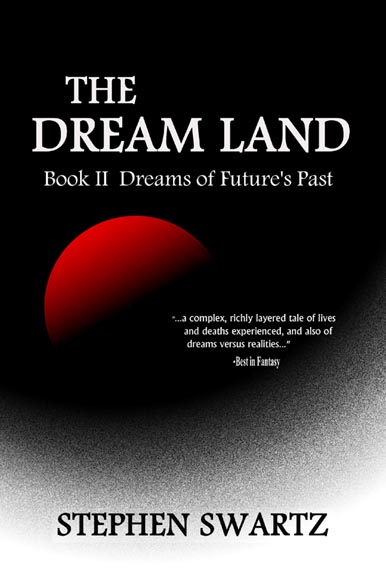
Introducing THE DREAM LAND Book II "Dreams of Future's Past"

Those of you who have been eagerly anticipating Book II of THE DREAM LAND Trilogy need anticipate no longer. It is here...er, well, over there at that Amazon place as a Kindle ebook. First things first, right? Let me catch my breath and I'll get started on the print edition as well as return to finishing Book III.


Some music fans will note the title of this novel "Dreams of Future's Past" and associate it with a music album by the Moody Blues. You would be correct. You may also complain that my title is not the same as theirs. You would correct again. While I liked the idea behind the title of their album enough to borrow it (and my book's original title was "Days..." rather than "Dreams..."), the exact phrasing they used did not quite fit the time travel idea of Book II. So I took some authorial license, with apologies to the Moody Blues, and changed it. You might also be delighted by how many Moody Blues references you can find in THE DREAM LAND Trilogy.


Here is a brief description:


When you conquer a new world, do you change its history or change yourself?
After his adventures in Book I, Sebastian Talbot (a.k.a. Set-d’Elous, legendary warrior) has exiled himself to a desolate island, content to laze away the days writing his memoir. Until the emissary from Queen Tammy arrives with a mission he cannot refuse. Tammy, the IRS clerk he took to Ghoupallesz in Book I, wants him to fetch the son she left on Earth. How could she return for him? She married the King of Aivana.

That mission raises desperate questions for Sebastian: If he can go back and forth through these interdimensional doorways and arrive in different time periods, perhaps he can do something to prevent the big war he fought through, the war that destroyed his family and millions of others. He returns to his Ghoupalle wife Zaura in the years he was previously away. While on patrol duty, he comes upon a young poetess he knows will become the rebel leader who helps overthrow the monarchy and causes the wars. What would you do?

Meanwhile, back on Earth in another timeline, Sebastian awakens from a coma and is helped in his recovery by Dr. Toni Franck. An affair develops—just as his opportunity for escape comes along. Later, as Sebastian/Set escorts teams of mercenaries back and forth to conduct their history-changing business, he tries to meet up with Toni again only to realize the police are still in pursuing him. Desperate to see her, he arranges a meeting only to have a SWAT team show up, cornering him. Can he escape through an interdimensional doorway this time?


THE DREAM LAND Trilogy continues in Book II with parallel time lines, world domination and alien romance, and as always the minutia of heroic minds playing god without a rule book. Cheer or jeer--it's up to you!

*     *     *

Take your first trip to the other side with THE DREAM LAND Book I "Long Distance Voyager"!


Then follow the further misadventures of absent-minded romantic hero Sebastian Talbot in THE DREAM LAND Book II "Dreams of Future's Past"!

And Book III "Diaspora" is well underway and should be coming out in December 2013 or early in 2014.


*     *     *

If you are new to THE DREAM LAND environment, let me offer you a description of Book I which should give you a sense of the overall story:

How far would you go to save the love of your life? Through a portal to another world?

Sebastian, that quiet tax examiner at the corner desk in the IRS service center, carries a dark secret: once upon a time he and his high school sweetheart Gina found a rip in the universe and stepped through it to a strange world of magical beauty.  
 
Far from being a Disney-esque playground, the world of Ghoupallesz bursts with cosmopolitan elegance, alien perversions, and political strife. Gina, the adventurous one, falls in love with the adventurous possibilities. Not Sebastian; always practical, he insists they return to Earth. Gina refuses so he goes back alone, vowing never to return. Yet he finds himself drawn back repeatedly--he calls it “research”--and often crosses paths with Gina. Sometimes he saves her, sometimes she saves him, forever soul mates. 
 
Now years later, life on Earth hasn’t gone well for Sebastian. Then the headaches revisit him, with flashes of memories from Ghoupallesz. Gina is in trouble again, he senses, and he must, as always, save her. Meanwhile, a pair of too-curious IRS co-workers have accidently overdosed on the Elixir of Love he brought back on his last trip and the antidote exists only on Ghoupallesz. With these co-workers in tow, Sebastian returns through the interdimensional portal, fearing it may be his final adventure. He must gather his old comrades from the war, cross the towering Zet mountains, and free Gina from the Zetin warlord’s castle before her execution. Perhaps then she will stay with him.  
 
But are his adventures to the other side real? Or are they just the dreams of a psychotic killer? That’s what the police want to know when Sebastian returns without his co-workers.  
 
THE DREAM LAND is a genre-mashing epic of interdimensional intrigue and police procedural, a psychological thriller marbled with twisted humor, steampunk pathos, and time/space conundrums.


Here is a review of THE DREAM LAND on the Connie J. Jaspersen's Best in Fantasy Blog and Carlie Cullen's blog.


THE DREAM LAND Trilogy 
is published by


in association with

---------------------------------------------------------------------
(C) Copyright 2010-2013 by Stephen M. Swartz. All Rights Reserved. No part of this blog, whether text or image, may be used without me giving you written permission, except for brief excerpts that are accompanied by a link to this entire blog. Violators shall be written into novels as characters who are killed off. Serious violators shall be identified and dealt with according to the laws of the United States of America.

03 June 2013

Conquered a world? Now what?

Apologies to my dear readers and followers for my previous blog posting. The need to block out spoilers practically ruined an otherwise fairly decent synopsis of THE DREAM LAND Book II "Dreams of Future's Past" and made it unreadable for most of you. I learned a lesson: blocks are not as humorous as I believed them to be. 

Please allow me to try again....

So let's say you've reached the pinnacle of your interdimensional voyaging career. You've discovered "tangents" (those pesky interdimensional doorways), made the journey to a new world, learned its language and customs, completely and convincingly infiltrated the society there, wooed and won a local beauty, made a family, insinuated yourself into the military and risen to a rank of command, lived through a revolution, civil war, and bellicose expansion of your adopted homeland into a full-fledged empire, survived the wars (including a deadly winter campaign), and been appointed the Mexas of a desert kingdom by the same IRS clerk you helped years before by bringing her to your world. You've reached the top of your career.

Now what do you do? 

As Mexas you sit in judgment of people, solving their petty problems, being regal, and having no future. So you exile yourself to a small island where you live alone, writing your memoir of interdimensional adventures, daring anyone to sail out to your island and bother you. Except for that IRS clerk, Tammy, now Queen of Aivana. She wants you to return to Earth and bring her son back. Hmm, to Earth? Where the police are still in pursuit of you because supposedly you killed a bunch of your fellow IRS employees years ago -- even though they actually slipped through the "tangent" following you and became lost on your adopted world, or they refused to give up their exciting lives there and return to Earth!

So you go, find Tammy's son Chuck jr. ("Chucker"), and reunite mother and son. Now what? Suppose there's more you can do that would fall into the category of benevolence? Perhaps there are other things you could change. You know you can come and go between the present, past, even the future, simply by altering the angle and position of the interdimensional doorway you use. So why not? Surely there are many possibilities for changing things, making the world a better place for you, your family, and everyone else. You might even prevent the big war you've already lived through! That certainly would make you a god.

Wouldn't it?

THE DREAM LAND Trilogy's Book II "Dreams of Future's Past" follows the further adventures of arch-hero Sebastian Talbot, a.k.a. Set-d'Elous, as he struggles to achieve godhood -- for better or worse -- and finally learn the lessons that the gods have kept secret for millennia: Be careful what you ask for, you might just get it! Then, of course, you might need to undo it....


Book II will be available for Kindle in June 2013.


---------------------------------------------------------------------
(C) Copyright 2010-2013 by Stephen M. Swartz. All Rights Reserved. No part of this blog, whether text or image, may be used without me giving you written permission, except for brief excerpts that are accompanied by a link to this entire blog. Violators shall be written into novels as characters who are killed off. Serious violators shall be identified and dealt with according to the laws of the United States of America.