Showing posts with label post-pandemic. Show all posts

25 September 2024

The Writing Life: Behind the Scenes of the FLU SEASON Series


Ever since we were stuck at home during our infamous lockdown era, when I blithely declared I shall write a pandemic novel because I then had enough time free to do it, I got into a regular pattern. I arose at about the same time as when I would go off to the job, grab some coffee, and sit myself at the computer freshly booted up. I would review any notes I'd made since the previous writing session as I started playing the musical soundtrack to the story. I usually had an idea of what came next so I would back up and read through what I'd previously written, editing as I went. I like to call this "thickening" the scene. I tend to write lean and go back to add all of the descriptions, character thoughts and feelings, and making sure there are enough nods and sighs. That sends me into unwritten territory. I do the best I can, knowing I will edit it the next day, and again later, as much as needed. As the music evokes the scene, I imagine sitting in a movie theater and watching the action unfold on the screen that's at the front of my mind. I try to get it all down on the computer screen as best I can.

The remainder of the day I do not write (but I continue to think through what I've just written and what may come next). Occasionally an idea flares up in the afternoon that will prompt me to write a little, at least enough that I won't forget it. Same with the evening. Once I am far enough into the story, it tends to stay with me, constantly playing in my head, sending me on scenarios of the next episode, running lines of dialog as though I've just left the theater after watching the entire movie. This cinematic process has been with me from before the pandemic pause yet it has especially been my method while working on the FLU SEASON series, which began as a stand-alone novel only to become a trilogy and now, as I work on the sixth book, a full series.

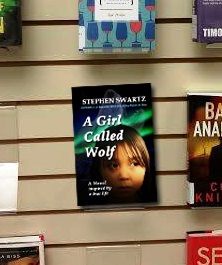
Perhaps it is easier working on a series because the world is the same, and you have the same cast of characters. However, characters grow up. That is my forte, I believe: being able to write a character as a child, then a teenager, a young adult, and on to an elderly person all while keeping the personality - and shifts of that personality due to aging and the various experiences which shape a person - identifiable as the same person. I first did that in my semi-biographical novel A GIRL CALLED WOLF where I fleshed out a compelling story of a more compelling real life of a friend of a friend. That book began in her infancy and took her up through her adult age. I hadn't planned anything but realized after finishing it that I had managed to achieve something special, yet I had to give credit to all of the then-recent study of psychology and life stages. With plenty of linguistic training, I could plausibly replicate the speech patterns of various ages, especially an uneducated child as well as an adult whose first language isn't English.

In the FLU SEASON series, I have done it again (hopefully) by bringing characters to life as babies and tending to them as they grow across the pages and even into a subsequent novel. Take Isla Baumann, for example, who is born toward the end of Book 1: THE BOOK OF MOM, narrated by Mom's teenage son Sandy. As a baby she doesn't have much to do, but in Book 2: THE WAY OF THE SON, when Sandy takes his wife and baby into the savage Outerlands, Isla starts to develop her own personality, even displaying unique supernatural powers in trying to communicate with her parents - who obviously do not understand her. At the beginning of Book 3: DAWN OF THE DAUGHTERS, Isla is a little girl of 4 and so attuned to her environment that she can serve as narrator of the novel. She goes through her life, from a child to a teenager, to young womanhood, to middle age and to the end of her days by the end of this book. Her perspective changes in keeping with the awful things and the good things that happen.

I'd thought that would be the end of the series, just a trilogy
that said most of what I wanted to get across to readers experiencing a realistic near-future following the hardship of a 10-year pandemic and collapse of society that resulted from it. But I had more ideas. Toward the end of Book 3, society was rebuilding, returning to some semblance of order although we find it rather skewed in unpleasant ways.

In
Book 4: THE BOOK OF DAD 
I bring in Isla's last child, a boy named Fritz (named after the family patriarch) who was born at the end of Book 3. Now he is a grown man with a family but in trouble with the government due to his making of a video of elderly Isla telling her stores about the decades of trouble she lived through. But now the government wants to disavow all of the hardship, the official narrative being that the pandemic was mild and the decades of lawlessness weren't so bad. Fritz is a nervous man and gets into further trouble in the novel, but doing so reveals much of what is wrong with the new, rebuilt society. In Book 3, Fritz's family is mentioned briefly. In Book 4, we meet his children: 2 brothers and young Maggie, all stuck in the oppressive capital city.

Fritz narrates his own story in Book 4, but we get a glimpse of a 10 year-old Maggie. In Book 5: THE GRANDDAUGHTER, she is a grown woman living out west and still figuring what to do with her life. She has the background of Isla's grandmother and father, who played the family's tuba before Isla took it over. But music is frowned upon in the capital and the tuba was put in a museum of naughty devices. The first step, Maggie decides with her older cousin Eve, is to return there and claim the tuba - if it still exists. Next she will start a kids band in her small town, enlisting the aid and advice of a music salesman from a nearby city. Both plans lead her into dangerous territory and constant trouble. By the end of the novel, Maggie is a mature woman set in her career. 

Maggie is the crossover character, tying the first three books to the second three books. Yet like the others mentioned above, she is introduced as a precocious child and we are allowed to follow her literally through her life into her senior years in Book 6: THE GRANDSONS (not yet published). Do not be confused by the title of this current work-in-progress, for the title refers to three characters who are each a grandson to one of the other characters - including a surprise guest in the final chapter. This final volume is expected to be ready later in 2025. I do not expect there will be a seventh book in the series; however, I will have set up the future world used in my already-publish epic fantasy novel: EPIC FANTASY *WITH DRAGONS, which is set in the year 8000. In it, those characters make frequent references to an ancient war which occurs in the year 3000. Maggie passes to her reward in the later-2100s with the world already going mad and mentions made of what is happening in Maggie's lifetime that foreshadows these future events. (I've blogged about this linkage previously here.) I also managed to tie in my vampire trilogy (A DRY PATCH OF SKIN, SUNRISE, and SUNSET) which, being pre-pandemic when written, had characters in 2028 fail to mention such an event, thus correcting the timeline.


After five completed books in the series, I feel I know each of the principal characters as well as my own family, perhaps better, as though I've lived with them all of their lives - which I actually have. I was there when they were born and again when they die. This is the reason for writing, for imagining. It is a kind of role-playing game which is acceptable in polite society. I can play in the garden of my own design, and in that time and place, I can live out my remaining days with a fair amount of pleasure - which I'm happy to share with you. Thanks, as always, for your continuing support.


--------------------------------------------------------------------- 
(C) Copyright 2010-2024 by Stephen M. Swartz. All Rights Reserved. No part of this blog, whether text or image, may be used without me giving you written permission, except for brief excerpts that are accompanied by a link to this entire blog. Violators shall be written into novels as characters who are killed off. Serious violators shall be identified and dealt with according to the laws of the United States of America.

14 October 2023

"1984" Reinvented as FLU SEASON 4

Probably not what you're thinking about today. You're likely focused on football, colorful leaves, Halloween, and pumpkin spice lattes. Certainly not the novel 1984 by George Orwell or countless movie versions of the story of a repressive society in the near future. To be honest, neither am I. However....

Like many teens, I first read 1984 for a class in high school. It was one sci-fi novel  which "felt" like a "normal" story - not my usual fare of space operas or heroic fantasy. What I liked about it was the dire setting; perhaps it fit my teenage mood of hopelessness. Our teacher pointed out the features of the story, what it is famous for, what this really means, and so on, but I never got the implications. Perhaps that was because in that decade we had no realistic fear of life changing too much from the way it was. I also was fascinated with the deliberate changing of the language for political purposes. I first dabbled with making my own language. (I would eventually create alien languages for my own sci-fi novels and study linguistics in graduate school.)

Later, when they made a new movie of the novel for the actual year of 1984, I was ready to understand all that it was suggesting. It wasn't that life had changed enough for me to see something new, something represented in the movie. For me, the movie was more about the downfall of a city, the cold and dull lives of the characters, and how depressing it all was. Seeing that film version prompted me to look for but not find my copy of the book, so I had to buy a new one. Even Apple, the computer company, had a 'Big Brother' advertisement in the Super Bowl of 1984. (By the way, I looked for one of those two copies for my research and did not find them so I had to buy yet another copy.)

More books and movies had a similar 'collapsed society' setting with idealistic characters who fought for a better life - either to destroy the new but cruel society or to take it over in the believe that they could undo the terrible changes. I liked the settings, but not the plots. These newer presentations were not new but rehashes of tropes from Orwell's novel. The main point in them was that if we the people do not stay aware, we could be repressed into a pointless existence. We could no longer live our lives in peace and safety, not to mention in comfort.

For the past few weeks - indeed, for nearly two years - I've bothered you with blog posts and promotional material about my latest creation, FLU SEASON, a trilogy about a family's struggles in an extended pandemic and the lawlessness that follows. In the second half of the third book, however, society is getting back on its feet again and life looks promising. But is that any way to end a trilogy? A happy ending? Really?

No, there's more. What seems to be good is, in fact, merely a facade which hides the evil machinations of a group of politicians who strive to achieve the ideal society - with them at the cushy top of the hierarchy, of course. That's the plot of many futuristic novels and movies. The difference I'm trying for is a natural extension of the story covered in my trilogy. Thus it is not strictly an imitation of Orwell's book but what would seem to me a logical progression from the way everything is at the end of Book 3: DAWN OF THE DAUGHTERS. Perhaps if I manage to set up the start of this slow revolution in my new "sequel to the trilogy", the story might then become like the situation in Orwell's book.

When we experienced our own pandemic in 2020 and I wanted to write a story based on it, I decided to start my story in the sixth year of the pandemic - when society had already gone downhill quite a bit. Following a period of anarchy, opposing territories begin to rebuild, fight a new civil war against each other, and finally settle into a more cohesive society. Technology that had been lost is reinvented, sometimes better. Other technologies are deemed less important in rebuilding (e.g., airplanes can wait). It is a society where there is electricity and there is a 'streaming' system (the equivalent of over the airways TV but not internet). There are also cameras and sensors everywhere - for citizens' own safety, of course, both in public areas and within each person's housing unit. There are roaming human safety monitors.

In this new Book 4, working title The Book of Dad, the story centers around Fritz, the last child of Isla Augustine Baumann (born in Book 1, grown narrator of Book 3). When Fritz is older he makes a documentary of his mother (Isla) telling about her life during and after the pandemic, thinking it is good to preserve the history of that era. But he learns it is the wrong history and some powerful people do not want it to be available. The result is trouble for Fritz. Trying to make a new life for himself after 'rehabilitation' and losing everything because of it, he is assigned a street sweeper job - because everyone must have a useful function in this new Ideal Society. Most of all he wants to know why he was targeted and who ordered him arrested years after the documentary was widely praised. What Fritz learns makes for a couple shocking plot twists that will blow the mind of readers of the trilogy. But no more spoilers.

My first consideration is always Will This Be Interesting? Next, I think about how the story embedded in the book will say something to readers beyond what happens in the novel. I don't write a novel to express philosophical ideas or push a message - but messages do appear on their own in the course of writing and I let them stay if appropriate. I also find, sometimes long after publishing, that a novel I wrote has a theme I never anticipated and certainly did not deliberately put into it. Book 3: Dawn of the Daughters has that hidden theme woven throughout that only on the fifth reading have I noticed. (Nope. Not going to tell you. Read it for yourself and see if you notice it.) In Book 4, I'm not pushing any 'watch out' warning; we already know what Orwell was telling us. But the way the drastic change sneaks up on us is what I'm going for in my Book 4 - rather than entering the story with everything already in a terrible condition, like in Orwell's book.

I hope Book 4: THE BOOK OF DAD will be out in Summer 2024...or what I like to call "our second 1984". As of this blog, we are close to 50,000 words.


--------------------------------------------------------------------- 
(C) Copyright 2010-2023 by Stephen M. Swartz. All Rights Reserved. No part of this blog, whether text or image, may be used without me giving you written permission, except for brief excerpts that are accompanied by a link to this entire blog. Violators shall be written into novels as characters who are killed off. Serious violators shall be identified and dealt with according to the laws of the United States of America.

19 December 2021

On the Compression of Time

Greetings! 

Welcome to the last blog post of this year, a not so prestigious milestone in a year of diminishing blog posts. I've been busy deciding how best to do nothing. Writing is my only escape. That's my story, anyway. To keep the record consistent, however, I am uploading this post. Time flies, even with a broken wing, so this post is about time in fiction writing.

When I was writing my semi-biographical novel A GIRL CALLED WOLF, I was working from the events of a real person's life - a remarkable narrative, I believed, and worthy of telling and sharing with the world. I had gotten to know the story's real heroine via Facebook (we had a mutual friend), and I interviewed her about her childhood in Greenland and what followed. However, when transforming someone's real life into a fictionalized version, I was struck by the conundrum of how to end the novel since she would continue on in real life while the novel would have an ending.

Taking the events of a life, twenty-five years at the time, and hitting only the highlights and omitting the rest is often a recipe for a cheesy Hallmark movie, which was not what I wanted. I had to put myself in the mind of a child describing an unfamiliar world, then as a teenager with teenage problems, then be a young adult discovering new worlds and adapting constantly to changing conditions. That was the kind of narrative that intrigued me, hence my desire to collaborate on this "based on a true life" novel. (You can read more about this project here.)

I learned clever ways to compress the timeline, sometimes going medias res (starting in the middle of the action) and backfilling needed info, for example. I divided the novel into longer chapters which corresponded to phases in her life, based on different locations as she moved from one home to the next. It was rather like writing a fantasy quest story but set in modern times - albeit with primitive conditions at the outset. It begins in the arctic and it ends in the arctic. The ending I chose, approved by the woman whose story I was writing, brings us full circle and provides symmetry and offers a profound message about resilience. 

For those readers who wish for an update (no spoilers for the book), Anna is quite well, living her life in Winnipeg, Canada - from where we last saw her heading north in the book. She had a real arctic adventure (with better results than in the book) during the covid crisis in 2020 working med-evac communications from a town in Nunavut. All is well with her and her son - and a new baby. 

A timeline story like A GIRL CALLED WOLF is what I seem to be writing now in my work-in-progress, POST. The chapters and the scenes within chapters parallel the day to day experiences of the cast. Some days are more interesting than others. I expend more text on the exciting days and next to none on the routine days. Such is the quirk of narrative. It's whatever the narrator deems worth narrating. In this new novel - a post-pandemic / post-apocalyptic tale of a boy and his mom and her tuba - I recount how they fled from a chaotic city hoping to survive in the countryside but finding dangers along the way. Changing plans and directions several times brings them to a new destination but one where all is not what it seems at first.

So again I am faced with telling the story of a family and their activities day by day. To speed things up, I skip days. I compress time. I slow down for real-time narrative and go into overview mode to get to the next interesting thing that happens. It's rather like the opera method (read more here) where the scene with the moment by moment action is the aria - a full set piece that displays detail, emotion, and purpose - while the other parts of the story are needed only to move you to the next aria, what we call the recitative. I enjoy writing the aria scenes (though often complex and challenging) and manage to type out some kind of recitative during the drafting stage to be filled out better later.

I find that I'm starting scenes ("sub-chapters") in my new novel most often with dialog, even as a short phrase, then filling in what's needed to know via the ensuing conversation. Otherwise, I begin with a setting description. For important plot points, you have to write out the scene in the detail you would find if acted out on stage. Cannot compress time, cannot gloss over, cannot merely suggest or hint at. You must write it out as though choreographing every movement and every utterance precisely. All right, yes, you can skip over mundane talk: instead of exact speech in quotation marks (e.g., "I shall go forth and write," the bard proclaimed.) you simply say what the character said without having to write out what he said exactly (e.g., The bard proclaimed he would go forth and write). 

Where's my books?
At 95,000 words, I should be nearing the end of my new novel. However, the way the story is proceeding, I could follow the cast members' adventures forever. I only need to invent more things for them to do. If not, I shall have to end it sometime, somewhere, somehow. I'm currently wrestling with how to end the novel. I have three ideas: a happy, hopeful ending; a sad/tragic but inevitable ending; or the vague could-go-either-way ending full of profound meaning. Place your vote in the comments below...and then go have yourself a wonderful holiday season.

Many thanks for your continuing patronage!


--------------------------------------------------------------------- 
(C) Copyright 2010-2021 by Stephen M. Swartz. All Rights Reserved. No part of this blog, whether text or image, may be used without me giving you written permission, except for brief excerpts that are accompanied by a link to this entire blog. Violators shall be written into novels as characters who are killed off. Serious violators shall be identified and dealt with according to the laws of the United States of America.