Showing posts with label stranger. Show all posts

20 August 2016

My Ruined Summer Vacation, Part 3

As a writer, I often set up my hero as a stranger in a strange land. Perhaps that's because I know so well what that feels like. Whenever I travel, I usually skip the conventional tours and get right out there walking the streets. I like to pretend I live wherever I am visiting. I wonder how it would be, how I would get along there.

So when I had the opportunity to teach a class at a university in Beijing last July, the little Chinese-style hotel across from the campus became my home sweet home. Having seen all the major sites on previous visits I spent much time in my room writing. However, when I did go out, I usually got myself into some kind of trouble. By my second week, I was ready to go on a longer venture away from my neighborhood.

The entrance to the neighborhood. The traffic barriers are new.
The rain was light when I left the hotel and walked the mile to the nearest subway station so I used an umbrella. Humid and hot, but not as bad as other days. I got some relief inside the station where cool air blew and on the subway train itself. Being a big boy now, I could follow the map and get myself to the right stop. We come to underestimate the need for basic skills when we are thrown into the stranger-in-a-strange-place scenario. I do not read Chinese but I did learn some of the characters while living in Japan in the 90s, so I could guess at the instructions on the ticket machine. (You always want to press the green buttons. Green is good.)

The street from the subway station to the park.
I rode the subway to the Tuanjiehu stop, named for the park near the hotel I stayed at when I first visited Beijing in 2007. The neighborhood looked very different this time, the trees grown out more, changing the lighting of the streets and sidewalks from what I recalled. But I recognized some of the same restaurants and other buildings from before. I took pictures of the park, despite the overcast, then had lunch at a Cantonese restaurant nearby. I had some dim sum and some char siu barbecue pork, which was very delicious. 

Then I walked about three miles over to Wangfujing street, the big tourist shopping area and browsed the book and music sections of the store I always go to there. (Last summer, I was accosted in the mall there by an "art hooker" who lured me into an art store to sell me art, which you can read about here.) Sadly, I found little to buy. I was getting tired of standing and/or walking, too. 

Entrance gate to Tuanjiehu Park on a rainy day.
Taking the subway back to the station near my hotel went according to plan. But somehow I exited the subway station walking the wrong direction. Somehow I always seemed to exit the wrong way, that is, exiting out a different one than I entered. Think of the four directions of the street intersection above the subway station. No problem, I thought. Just one mile more and I would be back at my hotel room.

The neighborhood looked different but that did not alarm me. I thought it was simply that the trees had grown out. I walked on, thinking I was going the right direction. Then I realized I was going in the wrong direction but I thought I would meet up with a cross street that would lead me back to the hotel's street. 

Tuanjiehu Park
But no! I was going the wrong direction. By the strange yellow-brown light in the cloudy/hazy sky I had no sense of north or south, east or west. Suddenly I did not know where I was or which way to go. I got angry rather than frustrated. It took so long to walk on to the next big intersection just to see what the street sign said. When I got to the next intersection, I pulled out my map and determined where I was at that point. I saw on the map that if I kept going this way, the way I was already going, then turned that way, I would be able to return to my hotel from the north instead of the south.

So I kept walking, my feet getting more sore and my hip joint starting to ache - because, as everyone knows, you tend to get older when you keep walking farther and farther away from your destination. By then, I was moving myself solely from sheer willpower, as the evening started to darken. 
Tuanjiehu Park

I got to the next big intersection - another one - and saw the signs of the avenues in each direction and found them on the map. I realized then that I was even farther away from my hotel. It was maddening! It seemed that none of the directions would be the right direction. I looked at the people strolling past me. I stared at my map. I wondered how I might ask for directions, not knowing any of the right words. I considered if I held up my map they would get the idea I was lost. But none of the people passing me looked like the right person to stop and ask.
Tuanjiehu Park

I sat on a bench there along the sidewalk for a few minutes. I was just about out of walking for the day. Although I did not count my steps, like some fitness fanatics might do, I knew when I had reached my limit. I had to save 15 of them to actually walk through the lobby of the hotel and get on the elevator up to my precious room 424. 

So I flagged down a taxi and showed the driver the card from the hotel which had a map on it. Thank goodness I kept that card inside my passport! The driver got the directions from that little map and took me to the hotel. I saw later that I had been getting close to the Beijing Olympic Park!

Tuanjiehu Park
When he stopped for me, he was heading the wrong direction to simply continue on to the hotel so it required a long turn around, getting on the highway a bit, then charging up narrow parked-car-choked streets and popping out somewhere behind my hotel. Took about 7 minutes of harrowing stunt-driving in the heavy traffic of Beijing. Cost me 20 yuan! But worth every jiao (penny) of the price, just to get me back to my home sweet home away from home again.

I stepped out of the taxi a block from the hotel, where there was a place to pull over. Thankfully, that put me right by the 7-Eleven store where I usually bought my drinks and snacks. So I got some drinks and snacks. I also got myself an ice cream bar, because I deserved to be pampered after all the stress I'd endured in the 90 minutes between exiting that subway station and stepping out of that taxi. 

I was sure glad to be home! Kinda embarrassing getting lost in the big city - more so when you actually have a map in your hand!


Sorry, I didn't feel like taking pictures while I was desperately lost so all I have are the pictures from earlier in the day (Tuanjiehu Park). The ice cream bar was good.


--------------------------------------------------------------------- 
(C) Copyright 2010-2016 by Stephen M. Swartz. All Rights Reserved. No part of this blog, whether text or image, may be used without me giving you written permission, except for brief excerpts that are accompanied by a link to this entire blog. Violators shall be written into novels as characters who are killed off. Serious violators shall be identified and dealt with according to the laws of the United States of America.

14 August 2016

My Ruined Summer Vacation, Part 2

Sometimes when you are a stranger in a strange land, you seek out any vestige of home as a way to recapture some sense of normalcy. For me, however, that theory does not often work out the way I expect. Especially during my month in Beijing to teach a course at a university. Like last summer, I had my weekly rituals.

Leaving the Yinghua Hotel for my stroll to lunch.
After my Wednesday class I could start the long weekend. I had plans to go to my favorite shopping street, Wangfujing Avenue, where the two bookstores are, but I didn't make it there. I awoke Thursday and Friday mornings and did some writing. By the time I ran out of steam it was noon so then it was too hot and humid to go out. On Friday I had a bit of Mao's revenge (like Montezuma's revenge but for China) so I stayed "home" in my hotel. It is possible to have too much Chinese food. I still went out for dinner but only after 5 pm. It was 95* with high humidity. On Saturday I made it to the KFC about a mile away but the menu was stupid and nothing like in USA, except for having chicken. 

Just a hole in the wall. Only the chicken was familiar.
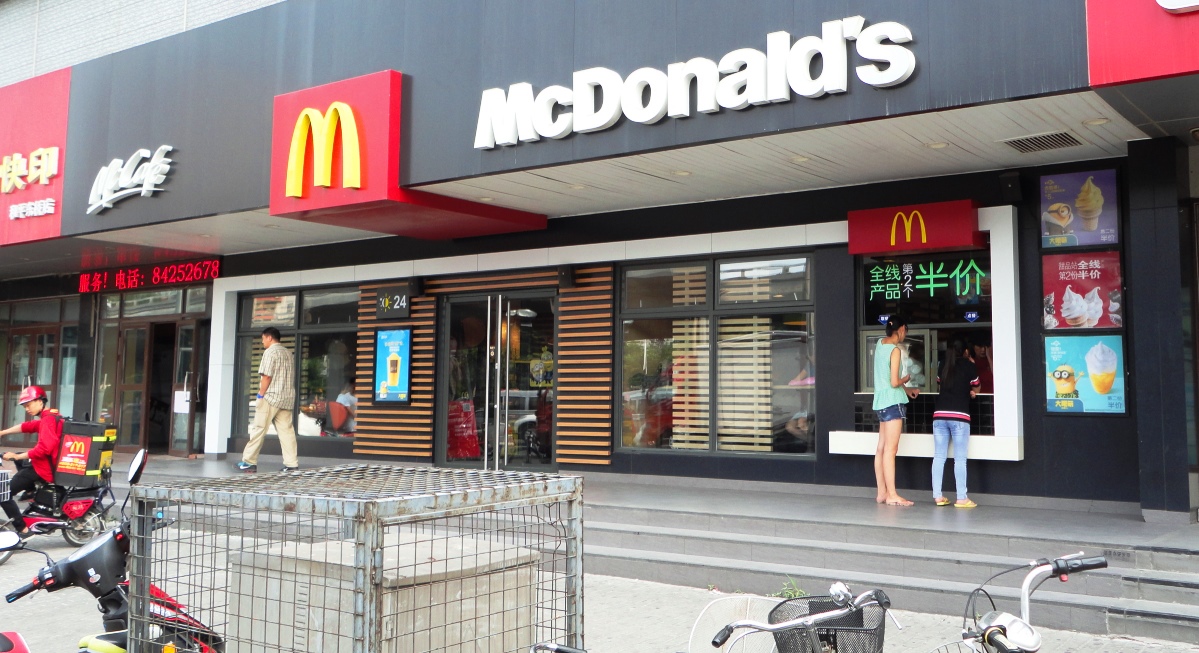
On Sunday, I went further, down to the McDonald's, which required me to cross a busy superhighway without getting killed. Once on the other side, I entered with great relief. I decided to order the special, thinking it would be easy to point to the sign and the counter person would understand what I wanted. Besides, it had a Hello Kitty theme so I knew I couldn't go wrong with that.

A girl at the McDonald's was loudly calling attention to the automatic ordering machines. I jokingly asked, in sarcastic tone, if it had English and she surprisingly replied in English that it did. So she talked me through it, step by step. I felt special. She pushed the on-screen buttons for me as I selected what I wanted. Basic cheeseburger and fries combo was good enough. Several steps to confirm my order, then . . . to pay for it through the machine. 
Outside McD's. The little window on the right is for walk-up orders. It requires speaking Chinese.
This marvel of technology only allowed payment using a phone app such as iPay or WeChat. I didn't have any of them. I thought I should have been able to slide a bill in and get change like at a grocery store, but NOOOOO! 

Inside McD's. The ordering machines are on the right. Bring your phone app to pay!
So I got back in the regular line to order, now two people longer. When I got up to the counter, the young man gave me a special menu for tourists; it did not have any more English on it than the menus overhead did but at least I could point more accurately than up at the menu above. I can really zero in with my index finger! Anyway, I went back to choosing the Hello Kitty special.

And I finally got my food, the special of the day: some kind of teriyaki sandwich (burger? not sure) with the usual fries, and a "bubble tea" - milk tea with tapioca balls in it. I thought it was iced coffee. I grabbed an ordinary straw for the drink but the "bubbles" clogged up the straw. The girl who tried to help me with the ordering machine rushed over with a big straw, saying emphatically "No, no, no!"  She switched the straws for me, stabbing a fat straw into my cup's lid before I could say "xie xie" ('thank you'). 
Before the straw switch, I had to walk around the crowded restaurant with my tray of food to find a place to sit. So many young people just sitting and chatting or using their electronic devices, already finished eating or not eating at all, or maybe with only a drink to buy them table time. It was a Sunday afternoon, of course. Finally I found a booth right up at the front by the ordering machines. It had leftover trays/food on it. I shoved them to the side and sat down, started to eat my meal. Two older women (i.e., my age) came over and asked in Chinese if they could share the booth. I waved them in and one of them got a McDonald's employee to clean off the table for us. We did not talk to each other but we did share a moment of humor when I gestured and made a face that the sandwich wasn't so good.

Then I got up to leave. But as I was stepping through the crowded restaurant, heading to the exit, I saw the McCafe section. So I got a large iced latte (large in China = small back home) and sat on a high stool at a tall table. As I sipped my kinda cold drink, I took in the ambiance of young ladies chatting with each other and playing with their phones. So, I played with my phone, as well, while I drank my coffee. In my Chinese-style hotel room, paid for by my employer, the wifi had various sites blocked: Facebook, Google and Gmail, Twitter, Instagram, etc. But I could still access Twitter and Gmail on my phone, via my phone service, so I checked what's going on. Unfortunately, there was not enough exciting action reported on those venues to entertainment for the length of my drinking and I left the McDonald's feeling sad.

Along the way to & from the McDonald's.
On the walk back to my hotel, I stopped by the 7-Eleven, as usual, and got some drinks to take to my room. I think there must be a law in Beijing that a 7-Eleven must appear once every two blocks. But for us foreigners, that is truly a godsend. I was a great customer during my month in Beijing: bottled coffee, breakfast pastries, lunch and dinner point-&-order Chinese dishes plus a box of rice, or pre-packed sushi, and fresh fruit, and all the packages of snacks and candy you could wish for. Plus cheap bottled water since you can't drink water from the tap. It provided a weird taste of home.

Then I fired up the laptop and went back to work on my epic fantasy novel. I had just finished the main story line involving the dragonslayer. Early on, I had started the second story line with a chapter then put it aside to concentrate on the first story line. Now I had to go back and finish the second story line, even though the dragonslayer's story was so long already. The two story lines would come together at the end. The second story line is all about the little princess - perfect for typing in a hotel room in Beijing when you've seen all the sights already.


---------------------------------------------------------------------
(C) Copyright 2010-2016 by Stephen M. Swartz. All Rights Reserved. No part of this blog, whether text or image, may be used without me giving you written permission, except for brief excerpts that are accompanied by a link to this entire blog. Violators shall be written into novels as characters who are killed off. Serious violators shall be identified and dealt with according to the laws of the United States of America.

02 May 2015

The Story of AIKO

Last month in this blog, I revisited Korea and got a good dose of nostalgic thrill. Further back in this blog I wrote about another trip to Korea. It's ironic, however, that much more of my time in Asia was spent in Japan. Five years total, in fact, which is a tenth of my life--or a sixth of my adult years! 

As a foreign teacher, my everyday mundane activities were not very exciting--unless you happened to be family members who were curious about everything I was doing there or you were interested in semi-rural and small town Japan life in the late 1980s and early 1990s. As it was, Japan was beginning its "internationalization" program, which included bringing thousands of English-speaking young people from the U.S., U.K., Canada, and Australia to Japan to help teach English in the public schools. 

I was one of them. It was an experience that was equal parts fascinating and frustrating. The fascination came from discovery of a completely new and different culture from what I had known in my own country, not the tourist sort but right down to the everyday getting through life kind of things. The frustrating part was trying to adapt to a set of customs that did not come naturally to me as well as trying to see things from a different perspective and understanding how in the world it could possibly work just fine that way.

I went first to Saga City, capital of Saga prefecture (state), on the southwest major island of Kyushu, and lived there for two years. I rotated with another American teacher among the city's nine middle schools--when the kids first start to learn English. The city was surrounded by rice fields as far as you could see. It had the remains of a castle. I rode a bicycle everywhere, sometimes the local bus. I ate mostly the Japanese food available to me although there were also plenty of fast food restaurants in town.

Enjoying the English teacher life, I decided it might be a good career move fpr me to become an official English teacher in the U.S., so I returned and entered an Education program back home. I completed everything but the student-teaching semester when I got an offer to return to Japan that I could not pass up.

With more credentials, I arrived in Okayama prefecture, mid-way between Hiroshima and Kobe on the main island of Honshu. I served as the one and only English teacher for three middle schools up in the mountains, living in the village where my main school was and commuting once each week to the other two. It was a picturesque landscape and I settled in rather comfortably. It felt odd when visiting relatives in America for Christmas holiday to "go home" to Japan; my apartment in Nariwa, Okayama felt more like my home than the Kansas City where I'd grown up.

I'm not sure where all this love for Japanese culture began. I can pick out a few starting points, but the main idea of telling all of this is to contrast my actual life in Japan with all the reports about Korea I've posted. They are two very different places--yet to the casual Western tourist somewhat similar. In blogging, I've tried to offer mostly the humorous side of my travels: the stranger in a strange land scenario, where I struggle to understand, often insisting my way is the best way, even the only way, then being soundly corrected. In such a way the stranger comes to appreciate, even prefer, the new culture.

It's kind of like James Clavell's Shogun, where the shipwrecked Englishman gradually becomes Japanese and takes his place in that feudal society. A similar transformation is depicted in the Tom Cruise film The Last Samurai. Those may have been full of cliches and stereotypes, of course (although I trust Clavell to get the facts straight). For some of us, there is something attractive about that culture. I gradually slipped into that culture, too, and I became a stranger when returning to the country of my birth. (Plenty of other examples of this kind of scenario exist that involve other cultures than Japanese.)

This "stranger in a strange land" theme seems to have become my writing focus, my stock in trade. All of my novels deal with characters being in a new and different place than they grew up in. I even took it so far as to have them visit another planet in THE DREAM LAND Trilogy; the Earthling travelers were both amazed and frustrated by what they found. That "stranger" theme usually involves someone also speaking a foreign language and speaking English imperfectly. I'm an English teacher by trade, after all, and a linguist by training, so the language aspects of characters have always fascinated me. (You can see a chart here of what places and languages are in each of my novels.)

So it should come as no surprise that my forthcoming novel AIKO follows that same theme: the stranger coming to the strange land and having to make his way and reach his goal, thwarted at every turn by the rules and customs he does not know, does not understand, or refuses to adapt to. The novel is also set in Japan, a place I feel thoroughly confident in describing--at least from the Western stranger's perspective. I lived in two places there and visited many other locations--all of the big tourist spots as well as places tourists do not visit. I also visited the locations in the novel. 

The story of AIKO is a quest to make things right, to restore a balance in the protagonist's and everyone else's lives. As with any good story, it begins with a conflict, a problem needing to be solved. Our hero tries to solve the problem but finds obstacles. He tries to overcome the obstacles but things get worse. He starts to believe he won't succeed yet fights harder, refusing to give up. Will he succeed or not is the story, of course. In that sense, it's quite simple. The beauty is in the details. 

I've chosen to set this plot in the Japan on the cusp of its internationalization program, a time in the early 1990s when old thinking clashed with modern thinking. The fate of a child is left to the effort of this stranger struggling through this strange land, who is trying to do the right thing--even at the risk of destroying his marriage and losing his career. The situation gets quite desperate for him as he is soon fighting the calendar as well as the bureaucracy Japan is famous for. And then there is the waitress who wants him to take her back to America and the gangster wannabes who just like having fun with this foreign guy.

It was only after writing the initial draft that I recognized some similarities between my story and the story at the heart of the opera Madame Butterfly--similarities which I sought to emphasize, even exploit, in subsequent drafts. I'll tell you about that next time.


---------------------------------------------------------------------
(C) Copyright 2010-2015 by Stephen M. Swartz. All Rights Reserved. No part of this blog, whether text or image, may be used without me giving you written permission, except for brief excerpts that are accompanied by a link to this entire blog. Violators shall be written into novels as characters who are killed off. Serious violators shall be identified and dealt with according to the laws of the United States of America.